Navajo Rugs
The tradition of Navajo Rug weaving combines many aspects of Navajo life into one enduring discipline. The materials, the method, the skill, and the meaning all come together, woven into one beautiful work of cultural art.

Sheep are very important to the Navajo people. The Wool Rugs woven by Navajo artists are made from this important part of the reservation. This gives the Navajo Rug a very close tie to the land and to life on the reservation. The most traditional Navajo weaving is made from wool dyed with natural materials collected from the plants and minerals found in the surrounding environment.
It takes great skill and a lot of time and patience to weave a rug. Just setting up the loom takes a lot of know-how and understanding about what it's going to take and what pitfalls can occur through the weaving process. The looms are very similar to what they used centuries ago but made from modern materials for added strength. The method is the same, carefully intertwine the thread in and out from one end to the other, then tighten with the shed stick, changing colors and thread all the time to create the pattern. This requires planning, incredible concentration, and patience. One thing people don't consider is the space required to weave a rug. About half of a whole room is required and the loom is set up along a wall from one end of the space to the other. So rug weaving is more than a hobby, it's a way of life! The Rug is a part of a weavers life and it lives with them while it is being created. It is born into the family and grows while everyday life continues around it.
Navajo Artist Ella Williams
The geometric patterns and designs of Navajo Rugs are the roots of the Navajo aesthetic. The traditional patterns have a unique history but the shapes and symmetry are the real core of the Navajo artistic theme. The meaning of Navajo Wool Rugs is more in the process than in the patterns on the surface. The meaning is in the tradition and the practice. The meaning is in the skills and techniques passed down for generations. They are about creating something useful, beautiful and enduring from very little. Each weaving is given a piece of the weavers spirit. Although they hope to get that piece back so they can continue to weave more rugs, the idea that they gave a piece of themselves to create the work of art is very true and this gives the rugs another layer of meaning.
Navajo Rugs are one of the the most special works of art that can be used to bring the feeling and energy of the Southwest to the decor of a room. At Alltribes, we appreciate the art of Navajo Rug weaving as much as the other arts, including the jewelry. Our collection reflects that appreciation and we have a wide variety of Navajo Indian Rugs & Blankets with all of the different patterns and styles, new and old, antique or modern. Find all of the styles here; Chimayo Rugs, Storm Pattern Rugs, Zapotec Rugs, Valero Star Rugs, Two Grey Hill Rugs, Saddle Blankets, Klagetoh Rugs, Wide Ruins Rugs, Antique Vintage Rugs, Tree of Life Rugs, and Ganado Rugs. Together with the owner, we have been buying and selling Navajo Rugs for over 50 years. The knowledge and experience is what gives our selection of Native American Rugs such a high quality and reasonable price.
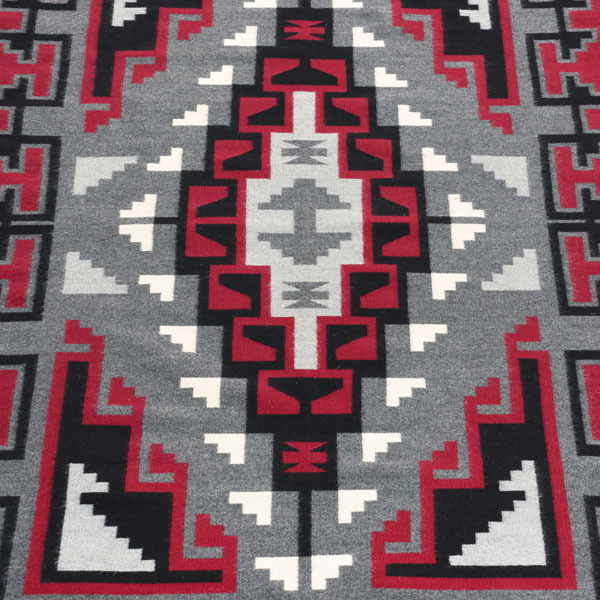
More about the patterns: Early American settlers moved into the southwest and set up trading posts to deliver the goods and artwork of the southwest tribes to the east. As the appreciation of Navajo Wool Rugs took hold back East, traders were buying Navajo Rugs by the pound and selling them back east by the bale. Over time the market and the traders influenced and encouraged the Navajo to weave blankets and rugs with distinct styles. Different regions and groups developed their own patterns which became a part of their identity. They included "Two Gray Hills", "Teec Nos Pos" and "Ganado". These were often organized black and white geometric patterns with red accents and focal points. The "Crystal" rugs had a more oriental and Persian influence, while the "Wide Ruins" and "Chinlee" offered eye-dazzling banded geometric patterns. "Klagetoh" used a unique combination of bold diamond type patterns to create its own look as did "Red Mesa". Many of these Navajo rug patterns exhibit a fourfold symmetry, which is thought to embody traditional ideas about harmony.
Today Navajo rug making is a fine art for which few young people have the time or patience. Fortunately, the tradition is still passed down - mostly within families. Weavers now choose whether to work with natural or commercial dyes based on cost and durability requirements. While many still weave the traditional patterns, there is a greater variety of designs and themes as artists include their personal expression and the younger generation brings new ideas into the tradition. Alltribes has the opportunity to buy, sell and trade with some of the best Navajo weavers in the Southwest.
Yei Bi Chei Rugs
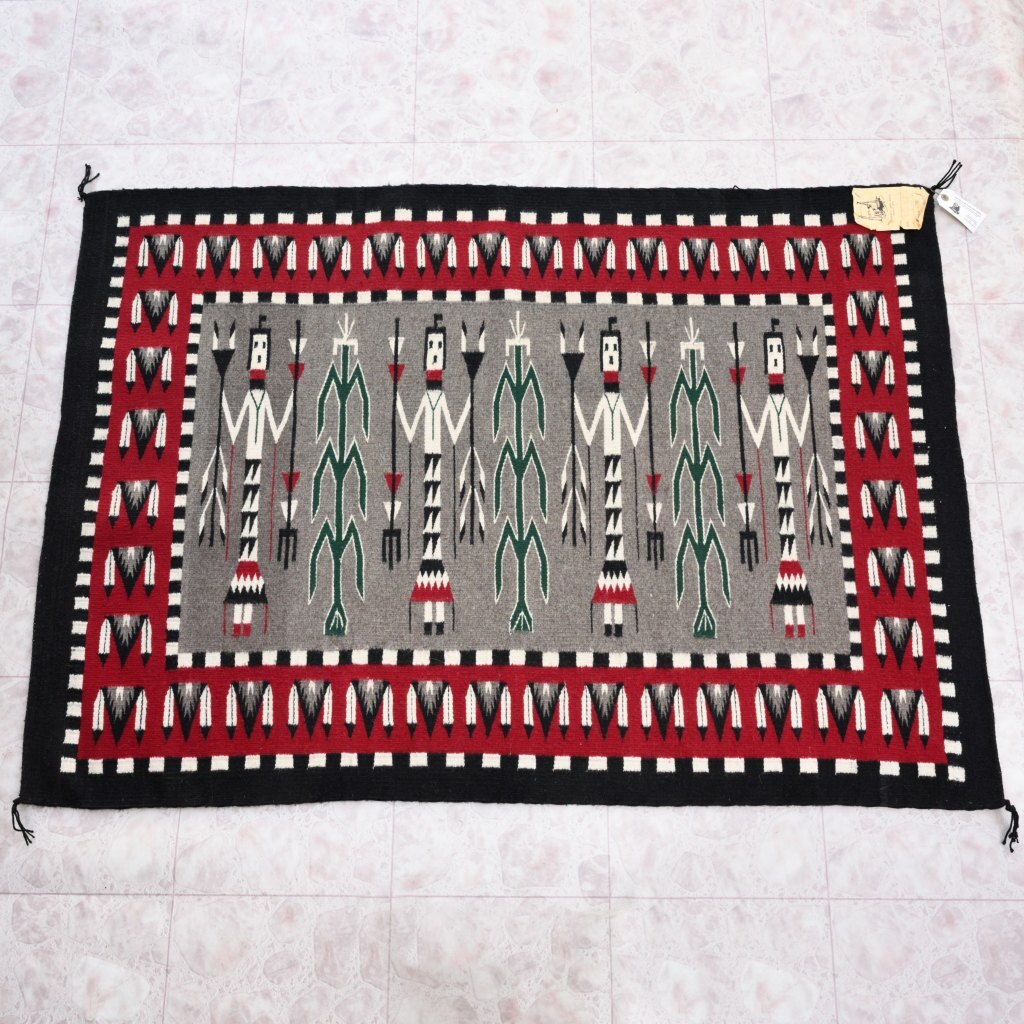
Navajo Artist Jackson Dean
Created with dyes made from natural vegetation indigenous to the Navajo reservation.
Yei-bi-chai and Yei rugs refer to rug designs that depict Yei, a Navajo Holy Person and the important nine day ceremonial dance that involves them. Over one hundred fifty years ago weavers deviated from the elders who did not want the sacred images to be used in weaving and started depicting the sacred dance and Yei dancers in their weaving. Although it was at first controversial to depict sacred images in the weaving, the tradition persisted and now there is a long history of Yei and Yeibichai rugs. Today, Navajo (Dine') people hang the Yeibichai rugs over their front doorway, which usually faces east, as a guard against evil and to honor the Sky and Earth.
The Legend of Spider Woman
According to Navajo (Dine') legend, it was the deity known as Spider Woman who taught a young Dine' shepherdess who was shivering from the cold the art of weaving upon a loom. After teaching her to sheer sheep, card, and spin wool Spider Woman told her: "My husband, Spider Man, constructed the weaving loom making the cross poles of sky and earth cords to support the structure; the warp sticks of sun rays, lengthwise to cross the woof; the heralds of rock crystal and sheet lightning to maintain original condition of fibers. For the batten, he chose a sun halo to seal joints, and for the comb he chose a white shell to clean strands in a combing manner." Spider Woman then warns the newly named Weaving Woman to "walk the Middle Way," keeping her life in balance and not to do too much of one thing. Good advice for someone taking on the challenge of weaving a large rug. Since Weaving Woman, the Dine' have always been accomplished weavers through the generations, hoping to pay proper homage to the Spider Woman and her husband.
By far the largest category of Navajo rugs would be non-regional, sometimes called "general rugs." These rugs do not exhibit unique characteristics that allow them to be pinpointed to a specific regional trading post area. Either no design elements stand out or the style of rug was, or is, woven throughout Navajo land. While Indian arts dealers will try assign a regional attribution to almost any rug, most rugs, in fact, fall into the non-regional category. The photo at right is only one example of a non- regional Navajo rug. There are many, many designs that fall into this category.
Spider Woman / Spider Rock stands with awesome dignity and beauty over 800 feet high in Arizona's colorful Canyon de Chelly National Park. Geologists of the National Park Service say that "the formation began 230 million years ago. Windblown sand swirled and compressed with time created the spectacular red sandstone monolith. Long ago, the Dine' Indian tribe named it Spider Rock. Stratified, multicolored cliff walls surround the canyon. For many, many centuries the Dine' built caves and lived in these cliffs. Most of the caves were located high above the canyon floor, protecting them from enemies and flash floods. Spider Woman possessed supernatural power at the time of creation, when Dine' emerged from the third world into this fourth world. At that time, monsters roamed the land and killed many people. Since Spider Woman loved the people, she gave power for Monster- Slayer and Child-Born-of-Water to search for the Sun-God who was their father. When they found him, Sun-God showed them how to destroy all the monsters on land and in the water. Because she preserved their people, Dine' established Spider Woman among their most important and honored Deities. She chose the top of Spider Rock for her home. It was Spider Woman who taught Dine' ancestors of long ago the art of weaving upon a loom. She told them, "My husband, Spider Man, constructed the weaving loom making the cross poles of sky and earth cords to support the structure; the warp sticks of sun rays, lengthwise to cross the woof; the heralds of rock crystal and sheet lightning, to maintain original condition of fibers. For the batten, he chose a sun halo to seal joints, and for the comb he chose a white shell to clean strands in a combing manner." Through many generations, the Dine' have always been accomplished weavers. From their elders, Dine' children heard warnings that if they did not behave themselves, Spider Woman would let down her web- ladder and carry them up to her home and devour them! The children also heard that the top of Spider Rock was white from the sun-bleached bones of Dine' children who did not behave themselves!